Imagine you’re racing against time to launch the next campaign because your biggest client wants a new product out in two weeks — or your investors are eager to see traction yesterday.
Your Slack/Teams channels are on fire with questions about ad spend, design approvals, and endless “Where are we with this?” updates. Meanwhile, your leads slip through the cracks because nobody remembers who was supposed to follow up.
If that scenario sounds all too familiar, you’re not alone. Many startup founders, agency owners, and CMOs at enterprise companies are juggling a million moving parts, often fueled by ad-hoc marketing tactics that never quite gel into a cohesive strategy.
In a hyper-competitive landscape, where digital transformation, AI, and data-driven decisions rule — random acts of marketing just don’t cut it. This is where a marketing system comes in: your blueprint for turning chaos into consistent, predictable growth.
Why Ad-Hoc Marketing Is Your Biggest Liability
Inefficiency:
According to Asana (2023), 68% of marketers waste precious time on repetitive tasks because they lack an organized workflow. Imagine paying your creative team to chase old leads instead of crafting your brand’s next viral campaign.
Inconsistent Results:
Gartner states that 60% of campaigns fail to meet ROI targets when there’s no structured system in place. For startups, that could mean missing a funding milestone. For agencies, it could mean losing key clients and for enterprise CMOs, it can lead to boardroom pressure and the dreaded question: “Where’s our ROI?”
Psychological Pain:
No founder wants to admit they’re scrambling. No agency owner wants to over-promise and under-deliver. No CMO wants to be caught flat-footed in front of an executive team. The fear of wasting resources—time, money, team morale—is real. And it’s exhausting.
What Exactly Is a Marketing System?
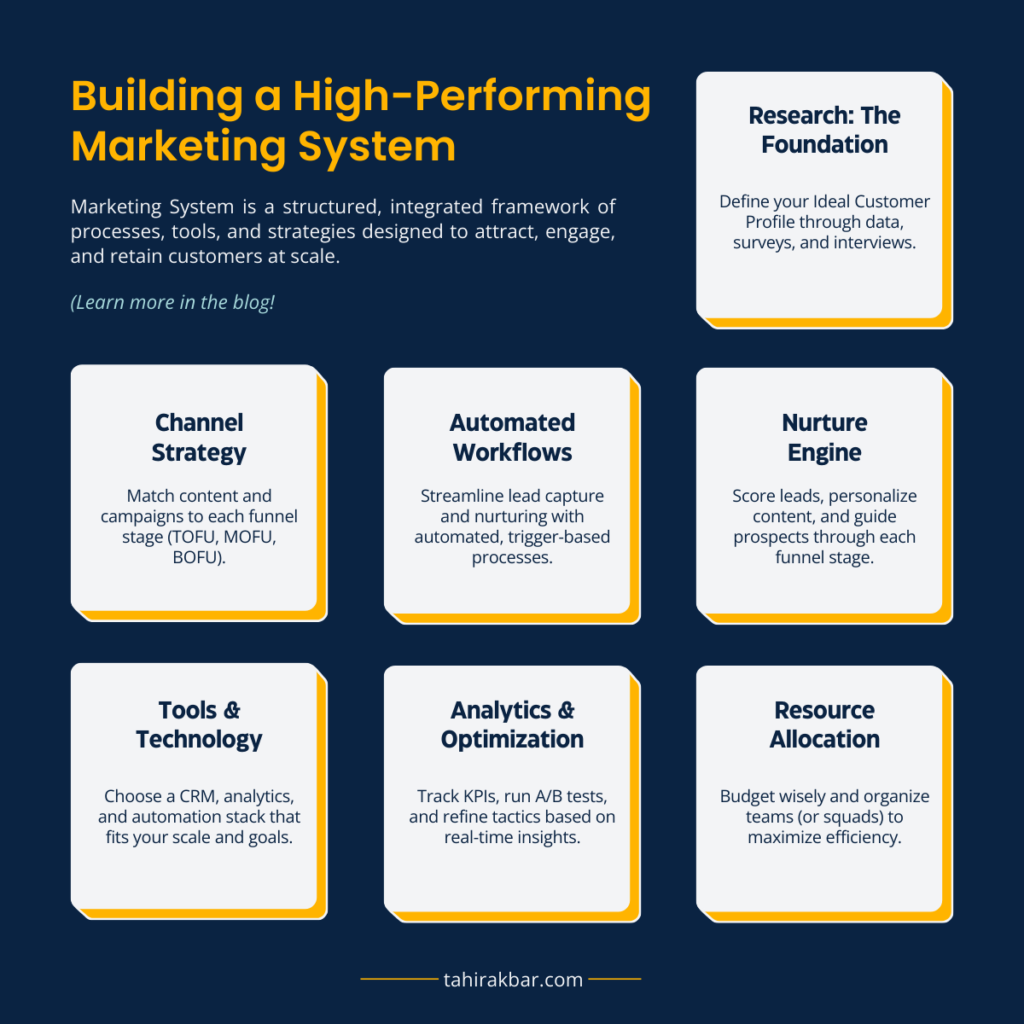
A marketing system is not just another campaign. It’s a structured, integrated framework of processes, tools, and strategies designed to attract, engage, and retain customers at scale. Think of it as a 24/7 growth engine that aligns every team member, every data point, and every resource toward one unified objective: sustainable, predictable growth.
From ‘One-Hit Wonders’ to Operational Excellence
- Then: 1980s–2000s marketing was mostly about mass media (TV, print). Personalization wasn’t even on the radar.
- Next: By the 2000s, digital marketing arrived, but each channel — email, SEO, social media —was siloed.
- Now: We live in the era of systems thinking, fueled by automation, AI, and omnichannel data. HubSpot set the standard with inbound marketing and automated workflows. Now, businesses that adopt a similar approach see 3x higher lead conversion rates.
Why Marketing Systems Are Non-Negotiable?
1. Predictable Growth
According to a 2023 report by CoSchedule, companies with documented marketing systems are 313% more likely to achieve their goals.
- For Founders: Predictable metrics keep investors happy and your runway stable.
- For Agencies: A proven system is a strong competitive advantage when pitching new clients.
- For Enterprise CMOs: Forecasting becomes more accurate, minimizing boardroom panic.
2. Operational Efficiency
The same study (we cited above) highlights that standardized workflows reduce task redundancy by 70%.
- For Founders: Free up your team’s bandwidth to focus on product innovation.
- For Agencies: Scale without stretching your staff too thin.
- For Enterprise CMOs: Streamline complex teams and budgets across multiple regions or departments.
3. Data-Driven Agility
Teams with robust analytics improve campaign effectiveness by up to 30% (McKinsey).
- For Enterprise CMOs: Justify each campaign with data, not guesswork.
- For Founders: Know which channels to double down on—fast.
- For Agencies: Quickly reallocate budgets to channels delivering the best ROI.
Core Components of a High-Performing Marketing System
1. Research: The Foundation
- Ideal Customer Profile (ICP): Analyze surveys, interviews, and CRM data to pinpoint demographics, pain points, and triggers.
- Competitor Analysis: Tools like SEMrush and Ahrefs reveal strategic gaps you can exploit.
- SMART Goals: Set Specific, Measurable, Achievable, Relevant, and Time-bound goals.
2. Channel Strategy
- TOFU (Top of Funnel): Blog posts, SEO, social ads for brand awareness.
- MOFU (Middle of Funnel): Webinars, case studies, email campaigns.
- BOFU (Bottom of Funnel): Product demos, free trials, ROI calculators.
Why It Matters: You align content with customer intent at each stage, so you’re not wasting time pitching product demos to people who just discovered your brand.
3. Automated Workflows
- Lead Capture: For instance, LinkedIn Ads → Dedicated Landing Page → CRM.
- Nurturing: Drip emails triggered by user behavior (e.g., abandoned carts).
- Visual Mapping: Use a simple flowchart (Fig. 1) to outline every touchpoint and trigger.
4. Tools & Technology
- CRM: HubSpot/Zoho (SMEs), Salesforce (enterprise).
- Automation: Zapier for quick no-code integrations, Marketo for advanced B2B.
- Analytics: Google Analytics 4, Tableau, or Mixpanel for real-time insights.
5. Nurture Engine
- Lead Scoring: Assign points for actions like email opens, page visits, and form completions.
- Personalization: Serve dynamic content (à la Netflix) based on user interests, purchase history, or browsing habits.
6. Analytics & Optimization
- KPIs: CAC (Customer Acquisition Cost), LTV (Lifetime Value), ROI, conversion rates.
- Tools: Looker Studio for data visualization, Hotjar for user behavior heatmaps.
- Continuous Testing: Employ A/B or multivariate tests on landing pages, email subject lines, and ad creatives.
7. Resource Allocation
- Budgeting: The CMO Survey recommends allocating 10–15% of revenue to marketing.
- Team Structure: Consider agile squads (content, paid ads, analytics) instead of traditional silos.
- For Founders: This ensures you’re investing only where it counts most.
- For Agencies: Smooth out capacity planning across multiple client engagements.
- For Enterprise CMOs: Align regional marketing spend with corporate objectives in real time.
Essential Tools for Modern Marketing Systems
A well-oiled marketing system depends on the right tech stack — one that streamlines workflows, amplifies reach, and delivers actionable insights. Below are the key categories to consider:
1. CRM Platforms
Your Customer Relationship Management system is your single source of truth. It centralizes customer data, tracks interactions, and helps you follow each lead’s journey—from the first touch to the final sale.
- HubSpot (Ideal for Startups & SMEs):
- Combines marketing, sales, and customer service in one dashboard.
- Best for teams looking for an easy-to-deploy solution with built-in automation.
- Salesforce (Best for Enterprise):
- Enterprise-level customization and scalability.
- Perfect for large teams managing complex, multi-regional operations.
2. Automation Tools
When you’re handling multiple campaigns and nurturing countless leads, automation saves you time, money, and headaches. It ensures consistency and frees your team to focus on strategy and creativity.
- Zapier:
- Connects thousands of apps (Slack, Google Sheets, CRM) without coding.
- Ideal for quickly automating repetitive tasks (e.g., transferring lead info from forms to spreadsheets).
- Marketo (Adobe):
- Advanced B2B automation.
- Builds complex lead-nurturing sequences, perfect for enterprise-level campaigns.
3. Analytics Suites
Data-driven decisions are crucial in today’s market. Analytics tools show you which campaigns perform best, where your traffic originates, and how users engage across platforms.
- Google Analytics 4:
- Free and privacy-centric.
- Gives detailed insights on user behavior and conversions; a must-have baseline.
- Mixpanel:
- Real-time funnel tracking and product analytics.
- Ideal for product-led growth strategies, especially for SaaS startups needing granular event tracking.
- Tableau or Looker Studio:
- Advanced data visualization for enterprise dashboards.
- Turns raw data into easy-to-digest, action-oriented reports.
4. SEO & Competitor Analysis
Search engine visibility remains a primary driver of organic traffic—and a key factor in building long-term brand authority. Robust SEO tools help you uncover profitable keywords, analyze competitor strategies, and optimize site health.
- SEMrush
- Comprehensive keyword research, backlink analysis, and rank tracking.
- Ideal for agencies juggling multiple client campaigns.
- Ahrefs
- Uncovers competitor backlinks, keyword gaps, and content ideas.
- Great for more in-depth link-building strategies.
- Moz or Ubersuggest
- User-friendly interfaces for keyword and site audits.
- Perfect for founders or smaller teams just starting their SEO journey.
5. Content Marketing Platforms
If SEO is the engine, content is the fuel. A content marketing platform centralizes your editorial calendar, manages distribution, and measures engagement—ensuring every article, video, or whitepaper ties back to your business goals.
- CoSchedule
- Handles content scheduling, social publishing, and marketing calendars in one place.
- Syncs well with WordPress for streamlined blog publishing.
- ClearVoice or MarketMuse
- Helps you discover content gaps, plan topics, and optimize for search intent.
- Ideal for data-driven content strategies, especially if you produce extensive articles or whitepapers.
6. Content Creation & Design
Engaging, high-quality content differentiates you from the sea of digital noise. Quick, user-friendly tools keep your brand assets consistent and your time-to-market minimal.
- ChatGPT
- Generates blog outlines, copy ideas, and creative prompts.
- Perfect as a starting point, but always refine with a human touch.
- Canva
- Drag-and-drop design for non-designers.
- Ideal for fast-turnaround social graphics, infographics, or webinar slides.
7. Project Management & Collaboration
Even the best-marketing strategy falls apart without clean, transparent task management. Project management tools keep your team aligned, deadlines clear, and deliverables on track.
- ClickUp
- Combines tasks, docs, goals, and chat in a single platform.
- Perfect for agencies handling multiple clients or startups needing an all-in-one solution.
- Asana
- Offers boards, lists, and timeline views.
- Ideal for teams that love visual workflows and want to track campaign progress at a glance.
Why These Tools Matter?
- Founders: By integrating SEO, content, CRM, and analytics from day one, you set the foundation for scalable growth without chaos.
- Agency Owners: Deliver consistency and measurable ROI across multiple clients, strengthening your retention and referral rates.
- Enterprise CMOs: Align global teams, unify disparate data streams, and produce board-ready insights that justify every dollar spent.
Remember, less is more. You don’t need every tool on the market — only those that address your unique gaps and enhance what you already do well. Start with the essentials — a CRM, analytics, and SEO tool — then scale up as you identify new needs.
Pro Tip: Conduct a quarterly or bi-annual tech stack review to prune redundant tools and explore emerging platforms that can further automate or optimize your marketing system.
How to Build Your Marketing System (Step-by-Step)
1. Audit Your Existing Processes & Tech Stack
Before adding new tools, figure out what’s working, what’s missing, and where leads or tasks fall through the cracks.
- Action Step: Use platforms like Process Street or Trello to map your current workflows — from lead capture to sales handoff.
- Key Questions:
- Are we losing leads because our CRM isn’t synced with our email campaigns?
- Do we have proper SEO tracking (e.g., keyword rank, site health) to feed our content strategy?
2. Identify & Prioritize Tools
Selecting the right tools ensures you avoid overload, where 43% of teams underutilize marketing software (Gartner).
Core Must-Haves:
- CRM (e.g., HubSpot, Salesforce) for unified lead and customer data.
- Analytics (Google Analytics 4, Mixpanel) to track digital interactions.
- SEO/Content Tools (SEMrush, Ahrefs, CoSchedule) for organic growth.
- Project Management (ClickUp, Asana) to keep tasks visible and on schedule.
Start small. Add complexity only when you see a clear need—like advanced lead scoring or in-depth backlink analysis.
3. Develop Playbooks & SOPs
A marketing system isn’t just about tools—it’s about repeatable processes. Documenting these ensures consistency and easier scaling.
Where to Focus:
- Content Creation: Outline your process for SEO-driven blog posts, newsletters, or social media.
- Lead Nurturing: Detail triggers for email workflows, retargeting ads, and sales outreach.
- Campaign Checklists: Break down each campaign (from brainstorming to execution) so team members can follow a proven blueprint.
4. Train Teams & Champion Data-Driven Culture
Tools don’t work if your team doesn’t know how to use them or interpret their data.
Action Step:
- Host weekly or monthly workshops on new features, best practices, and cross-functional workflows.
- Encourage certifications on HubSpot Academy, Google Analytics, or Marketo University to keep skills sharp.
Culture Tip: Celebrate wins driven by data insights, whether it’s a successful SEO optimization or an A/B test that boosted conversion rates.
5. Create a Content & SEO Backbone
Organic traffic and high-value content are long-term growth engines.
Implementation:
- Keyword Strategy: Use SEMrush or Ahrefs to identify relevant, low-competition keywords.
- Content Calendar: Plan weekly or monthly content using a platform like CoSchedule (or Asana) and assign topics based on audience pain points.
- On-Page Optimization: Leverage Yoast (if on WordPress) or SurferSEO to fine-tune meta tags, headings, and readability.
6. Implement Automated Workflows
Manual tasks create bottlenecks, especially when leads need immediate follow-up.
- Common Automations:
- Lead Capture: LinkedIn Ads → Dedicated Landing Page → CRM.
- Nurturing Sequences: Use Marketo or HubSpot to trigger email flows when leads download an eBook or visit a specific page.
- Social Sharing: Integrate Buffer or Hootsuite to auto-publish and track social engagement.
- Pro Tip: Start with small automations (like weekly analytics reports via Zapier) and expand to more complex sequences as you grow.
7. Optimize & Refine Continuously
Markets evolve, and your system should too. Regular reviews keep your marketing machine efficient.
- Metrics to Track:
- SEO: Keyword rankings, organic traffic, domain authority.
- Lead Quality: Conversion rates by source, lead scoring improvements.
- Funnel Performance: TOFU and MOFU drop-off points, time-to-close, and cost-per-acquisition (CPA).
- Action Step: Conduct quarterly or biannual system audits—prune underused tools, integrate new features, and run fresh A/B tests to push conversion benchmarks.
A full-stack marketing system doesn’t happen overnight. It’s the result of targeted tool selection, transparent processes, team training, and ongoing optimization. By methodically building each step — from auditing your current setup to fine-tuning SEO and content — you position your organization for sustainable, predictable growth.
Avoiding Common Pitfalls
Tool Overload
- Challenge: 43% of teams underutilize martech due to complexity (Gartner).
- Solution: Evaluate tools based on actual needs, not hype. If you find overlaps, consolidate or decommission underused platforms to keep your workflow streamlined.
2. Ignoring Data
- Challenge: Only 26% of businesses have a single, unified view of their customer (Salesforce).
- Solution: Invest in data integration early — your CRM, automation platform, and analytics suite should speak the same language. This ensures insights are accessible and actionable across teams.
3. Misalignment Between Teams
- Challenge: Marketing and sales misalignment costs $1 trillion annually (HubSpot).
- Solution: Establish a rhythm of regular communication—weekly or biweekly meetings. Create shared dashboards so both sales and marketing operate from the same metrics and milestones.
If you crave sustainable growth, your marketing system must be cohesive. No single tool, channel, or department can succeed in isolation. Integration is everything.
Conclusion
A robust marketing system isn’t a luxury; it’s the price of admission in today’s crowded marketplace. By weaving structure, automation, and real-time data into one cohesive strategy, you’ll transition from haphazard wins to sustainable, predictable growth.
Picture the relief of knowing your funnels are finely tuned, your leads receive timely follow-ups, and your data clearly signals the right decisions — whether that’s adjusting a paid campaign or doubling down on a high-performing webinar. It’s the difference between reactive chaos and proactive scaling.
Ready to Scale? Your Next Step
If you’re serious about turning your marketing chaos into a predictable growth engine, let’s talk.
- Schedule a free consultation
- Drop me a line at hello at tahirakbar.com
We’ll create a tailored marketing system that aligns with your unique goals—so you can focus on building, delivering, and growing, while your marketing engine runs smoothly in the background.
Because the future belongs to those who systematize — and your time starts now.